Start with your movement
Choose a useful movement, such as reaching or turning. Describe where it feels limited and what you want to do more comfortably.
 RECOVERYChoose your first visit
 DERMAL-FASCIAL RESTORATION® · AUSTIN, TX
When a local pulling sensation makes a reach or turn uncomfortable, Chris may use focused skin contact as part of your care. Dermal-Fascial Restoration® (DFR) can fit alongside FST or massage.
Choose your first visitFirst visit · 60 minutes $165 / 90 minutes $235
With Chris Corona · DFR training completed in 2024

01 / LOCAL CONTACT · CONTINUOUS FEEDBACK
Chris applies controlled tension at the skin in a selected area, then checks the same movement with you. Your feedback guides the direction and amount of contact.
The contact stays local and changes with your feedback. Tell Chris what feels comfortable and when you want a change.
Choose a useful movement, such as reaching or turning. Describe where it feels limited and what you want to do more comfortably.
Contact at the skin applies tension in different directions. Chris adjusts contact to your comfort; more force is not the goal.
Repeat the agreed movement and describe any change. This helps guide whether to continue, adjust, or use another approach.
02 / PART OF A PERSONAL PLAN
DFR can be considered alongside Chris’s other methods. Each has a different role. The mix and order follow your response, with no fixed sequence or need to use every tool.
For example, you might compare a comfortable reach before and after local skin contact, then explore supported movement with FST. Chris adjusts the order to you.
DFR is not usually needed on a first visit. For DFR outside FLEX, Chris explains the fee before you agree to it.
DFR offers local skin-tension work. FST adds supported movement across a wider region. Chris can recheck a reach or turn to see whether either approach feels useful.
Explore FST ↗Massage uses soft-tissue contact and pressure. DFR offers a different way to work locally at the skin. Chris can vary the balance with your feedback.
Explore massage ↗DFR is included at no extra charge when selected for FLEX. Chris uses it when it fits the visit, alongside FST and massage.
Explore Flex ↗Tape is another optional supporting tool. Its contact stays on the skin after application. Discuss skin sensitivity and whether tape fits your plan.
Explore kinesiology tape ↗03 / CLEAR EXPECTATIONS
Chris checks whether local skin contact is suitable before care. DFR does not replace medical assessment, rehabilitation, or appropriate physical activity.
New or unexplained symptoms may need medical assessment before bodywork. Chris can help you decide whether to discuss your concern with your clinician first.
Discuss wounds, irritation, easy bruising, reduced sensation, and recent procedures. The area may need a different approach or time to heal.
A scar needs an appropriate stage of healing and consideration of your clinician’s advice. A closed surface alone does not confirm readiness for treatment.
Ask for less tension, a new position, or a stop at any time. Tell Chris about sharp or electric pain, new numbness, or dizziness.
YOUR NEXT STEP
Book your first visit with Chris. Bring your goals and questions. Chris will explain the options and begin care at a pace that feels right for you.
Choose a first visit and tell Chris what feels difficult. DFR is not usually needed at this visit. Chris will explain the options and any fee before you agree to care.
No. DFR uses controlled skin tension. Massage uses a range of soft-tissue contact and pressure. Chris can explain how either may fit your session.
No. Tell Chris if contact is uncomfortable. He can change the tension, position, or method, or stop. You do not need to push through pain.
Discuss when and how the scar formed, how it has healed, and any restrictions from your clinician. Chris considers this before deciding whether local contact is appropriate.
There is no fixed number for everyone. Review your response and goals with Chris before deciding on further care.
FIRST-VISIT PRICES
New clients: choose “FIRST TIME CLIENT” in MassageBook.
First visits must be paid in full in advance.
Choose the amount of time that feels right for you. Both visits include a conversation, movement review, and hands-on care. The 90-minute option gives you another 30 minutes together.
The first 15–20 minutes are for your history, goals, and movement review. Hands-on care follows within your appointment time.
Your time is one-to-one with Chris in his private studio. The support, pace, and pressure follow your needs.
Optional kinesiology taping adds $20 to a first visit. DFR® is not usually needed at the first visit.
Returning client? Book your next sessionOPTIONAL READING
OPTIONAL READING
Physical therapist Paul Mettler developed the method, first called the Mettler Release Technique. The DFR Therapy Institute dates its beginnings to 1991 and the DFR name to 2018.
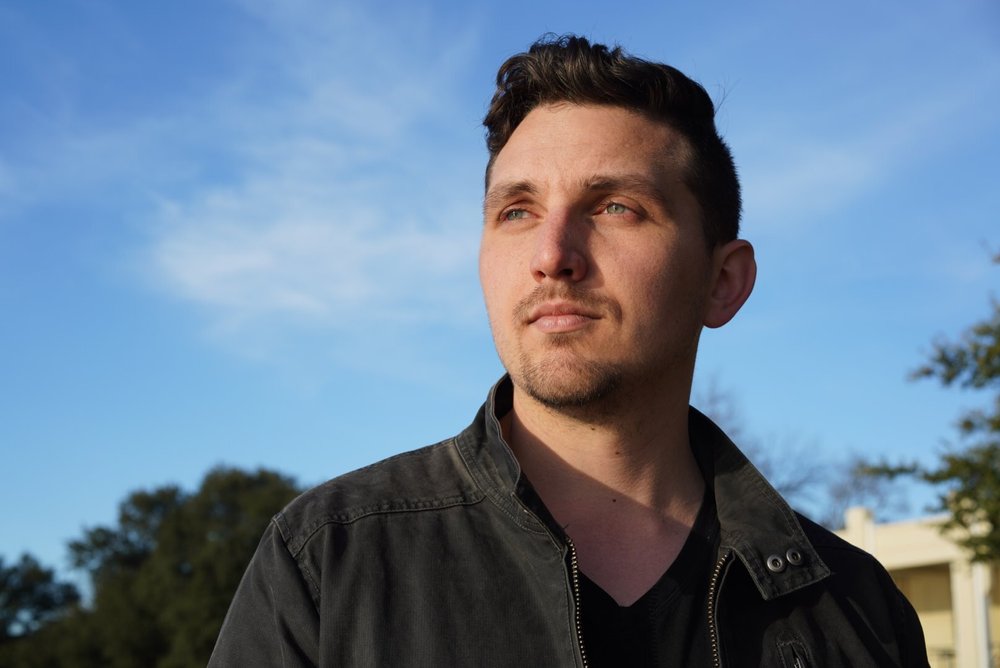
CHRISTOPHER CORONA
Chris combines DFR training with massage and Fascia Stretch Therapy in his Central Austin practice. The choice of method follows your goals, health history, and response.
Chris trained in Dermal-Fascial Restoration at the Stretch to Win Institute in 2024.
His FST training brings supported movement and stretching into the same conversation.
Chris holds Texas massage license MT133029. His background in biomechanics informs how he looks at movement.
OPTIONAL READING
Skin and the connective tissue beneath it are linked. Movement at the surface can transfer force through these connections. The response depends on the region, the tissue, and the force applied.
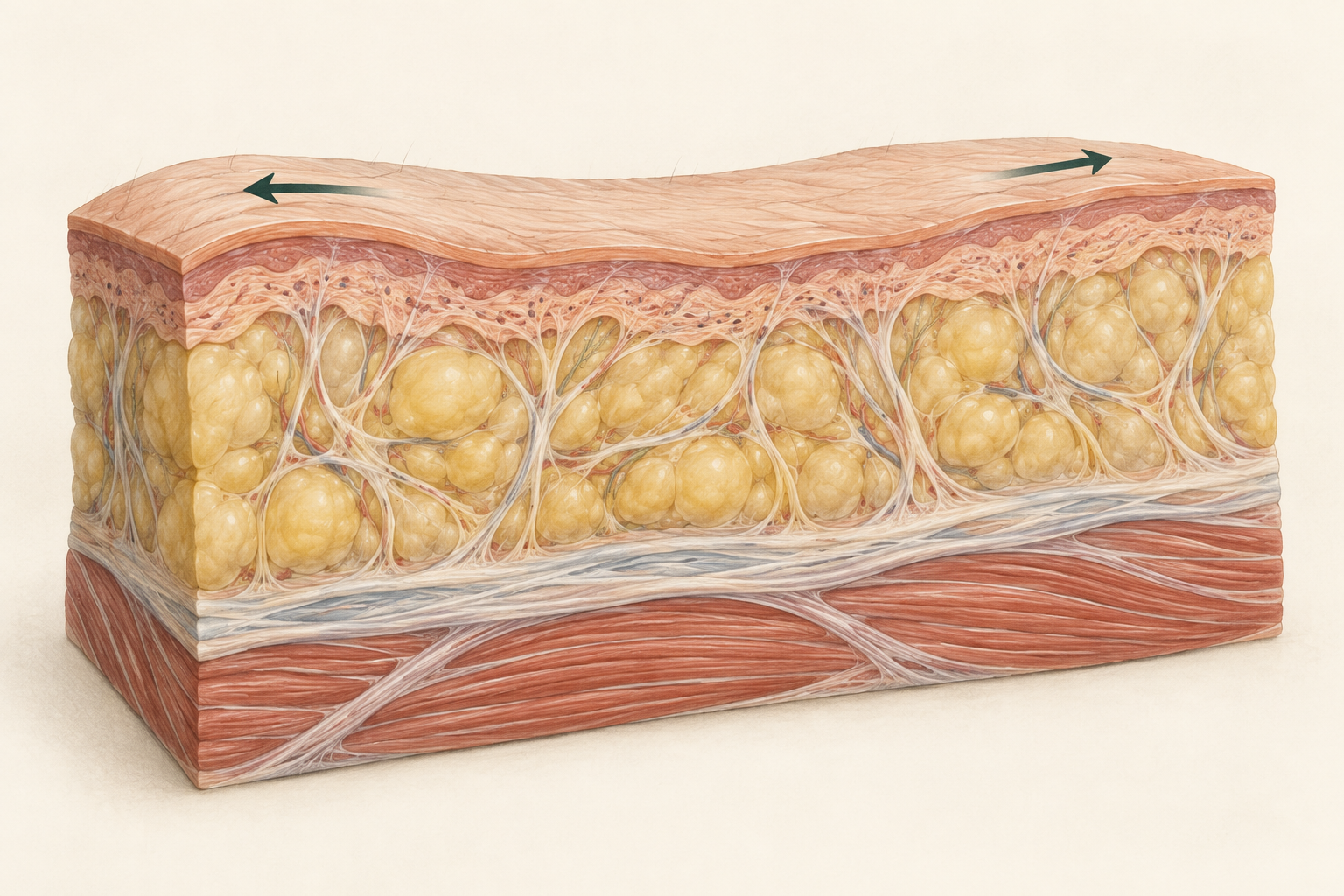
The image is a concept model. Tissue layers vary across the body. A feeling of tightness does not prove that layers are stuck together.
The outer covering receives the contact. Tension travels along its surface; this differs from pressing deeply into a muscle.
Fat and connective fibres lie below the skin. These structures connect and separate neighbouring tissues.
Fascia is connective tissue around and within the body’s structures. Adjacent tissues can move relative to one another; they are not independent loose sheets.
OPTIONAL READING
DFR has a proposed mechanical explanation: tension at the skin can move connected tissue beneath it. What this means for pain, function, and lasting change is a separate research question.
The ultrasound report is an early mechanism observation, not a controlled trial of clinical benefit. It does not establish that DFR breaks adhesions, restores circulation, or heals an injury.
A DFR ultrasound abstract reports movement beneath the skin during opposing skin tension. This is an observation during loading.
Neighbouring tissues can shift by different amounts. Observing that movement does not show that an adhesion has been removed.
Changes in how contact and movement feel may contribute to a session response. The abstract does not isolate a sensory mechanism.
The report proposes that mechanical force could affect connective-tissue cells. It does not demonstrate tissue repair or lasting cellular change in clients.
The abstract does not establish how much relief to expect, how long a change lasts, or whether DFR works better than another treatment.
Recheck the same task and discuss comfort and ease. A change can help guide care without proving why it happened.
Reviewed by Chris Corona · Review confirmed