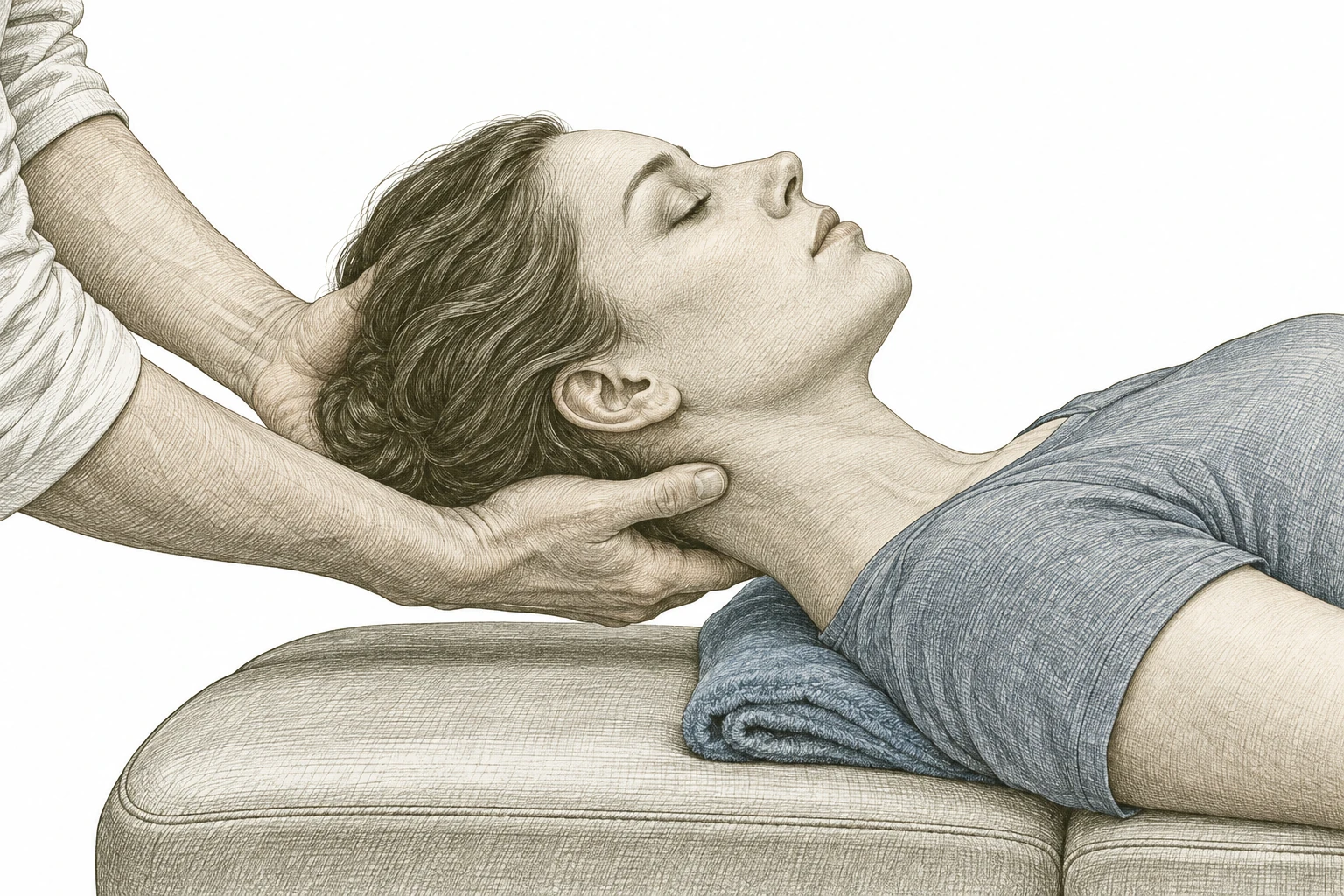
FST for neck restrictions
Chris supports your head and guides comfortable turning or tilting, with attention to your shoulders and upper back. Small changes in angle and support let him adapt the movement to you.
 RECOVERYChoose your first visit
 HEADACHES & MIGRAINE · AUSTIN, TX
A stiff neck or a tight, heavy feeling across your forehead can make an already difficult day harder. Chris works with you to ease these restrictions, explore more comfortable movement, and adapt touch to your sensitivity.
Choose your first visit ↗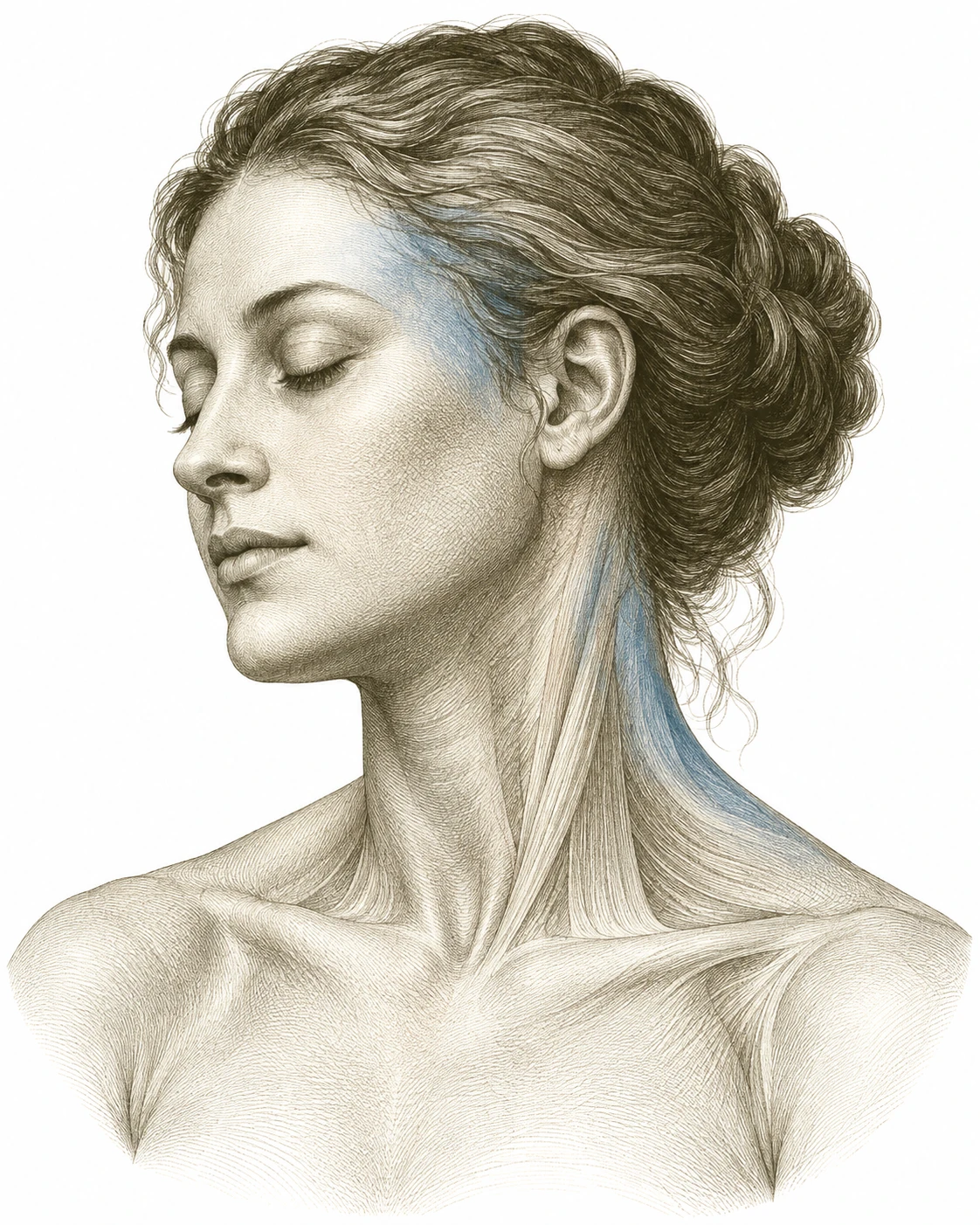
Before you visit: health and comfort guidance ↓
01 / LESS TENSION · EASIER MOVEMENT
Chris uses supported neck movement and gentle soft-tissue work around the forehead, temples, and scalp. Start with the area that feels tight, with touch and support adjusted to your sensitivity.
Chris supports your head and guides comfortable turning or tilting, with attention to your shoulders and upper back. Small changes in angle and support let him adapt the movement to you.
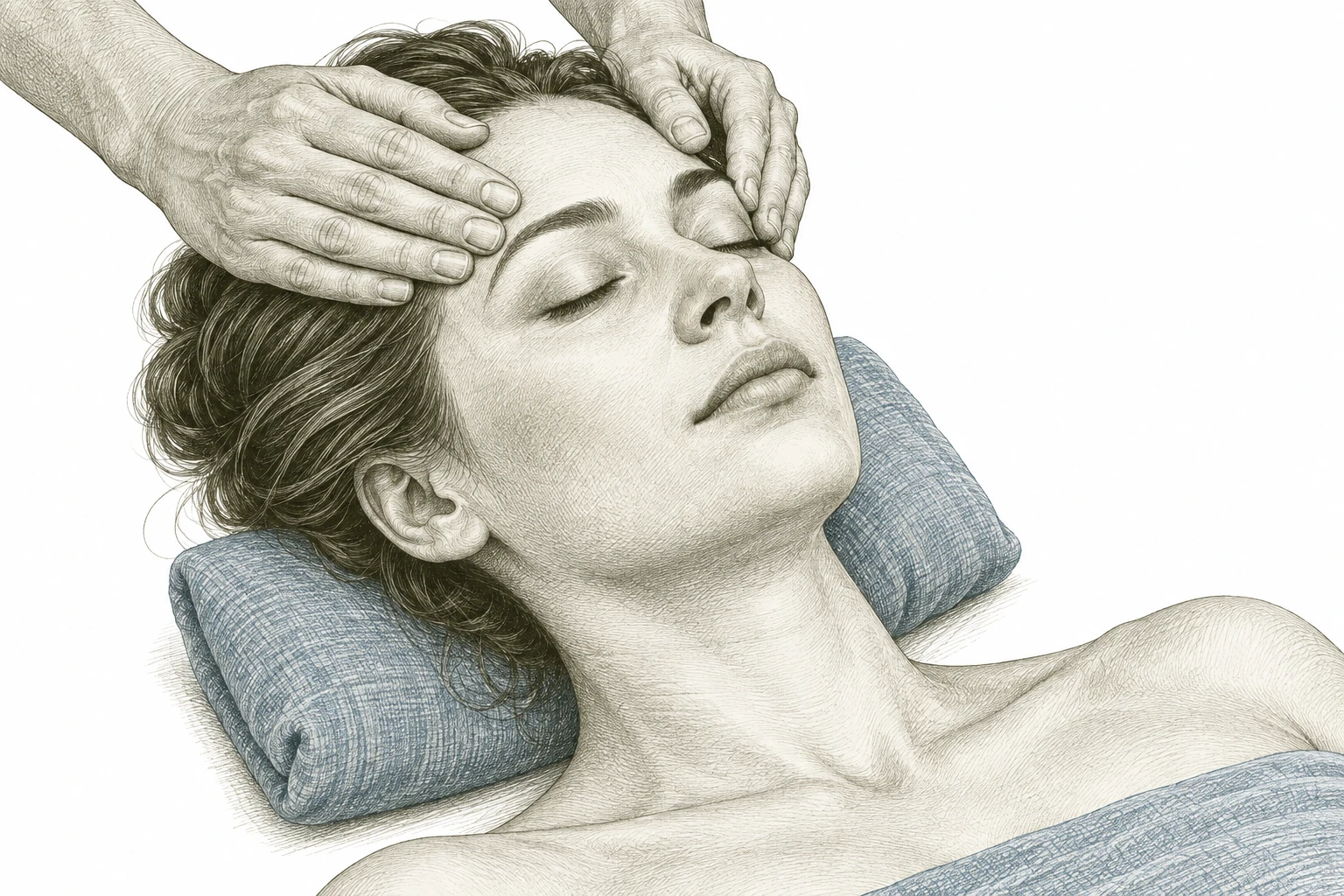
Gentle contact can focus on skin and soft tissues that feel tight or tender. You and Chris agree on the area and pressure before he begins.
Try a comfortable turn of your head before and after care. Notice neck movement and head comfort separately so you can describe what feels useful.
Care focuses on comfort and movement alongside your headache treatment.
Direct FST evidence for neck pain is preliminary. A 2023 study followed 15 people with mechanical neck pain through one week of a technique described as fascial stretching with a muscle contraction-and-relaxation pattern. Pain and neck movement improved, but there was no control group. The study cannot establish lasting benefit, migraine relief, or nerve decompression.
Evidence for headache that comes from the neck is more developed. A randomized trial of 200 people found benefits from specific neck exercise and manipulative therapy. Those treatments differ from FST, so their results do not establish the same benefit for Chris’s method.
Migraine findings vary by treatment. A 2022 trial of 42 people found that neck strengthening did not outperform its comparison treatment for headache frequency or intensity. A 2025 trial reported benefits from combined manual therapy, exercise, and pain education. Neither trial tested FST or proved that removing pressure from a nerve explains improvement.
Research on electrical vagus nerve stimulation concerns a medical device. Its findings cannot be transferred to hands-on neck or forehead work. Treatment goals here are easier movement and greater comfort, with headache frequency tracked separately.
Ragunath, 2023: FST and mechanical neck pain · Jull et al., 2002: neck-related headache trial · Benatto et al., 2022: neck exercise and migraine · Tolentino et al., 2025: combined migraine care · PRESTO: vagus nerve stimulation trial
02 / A VISIT THAT FITS YOUR SYMPTOMS
Tell Chris what your usual headache feels like, what makes it worse, and which positions feel comfortable. Continue your prescribed headache care.
Share your diagnosis, recent changes, neck injuries, and any movement limits from your clinician. Discuss sensitivity to light, sound, scent, or touch. If an attack is active, contact Chris to decide whether to adjust or delay the session.
Agree on head support, pressure, and movement range. Tell Chris if pain increases or you feel dizziness, nausea, numbness, or an unusual sensation. Stop the technique and review the next step.
Record neck comfort, useful movement, headache days, and any delayed flare. This helps you and Chris decide whether care is useful and how to adjust it. Seek medical advice for a new or clearly changed headache pattern.
Seek emergency care for a sudden severe headache that peaks within a minute, new weakness or trouble speaking, confusion, or a headache with fever and a stiff neck. These symptoms need medical assessment before bodywork.
Read more: NINDS: headache symptoms and medical care
YOUR NEXT STEP
You do not need to select a technique before booking. The first visit gives you and Chris time to discuss your goals and begin suitable care.
Contact Chris if an attack is active. Discuss touch, light, sound, and position sensitivity so you can decide whether to adjust or delay the visit. A new or clearly changed headache needs medical advice.
Gentle contact with the skin and soft tissues around your forehead, temples, or scalp. Chris explains the area and adjusts the pressure to your comfort.
The aim is easier neck movement and greater comfort. Migraine frequency may not change, so continue your medical plan and track headache changes separately.
FIRST-VISIT PRICES
New clients: choose “FIRST TIME CLIENT” in MassageBook.
First visits must be paid in full in advance.
Choose the amount of time that feels right for you. Both visits include a conversation, movement review, and hands-on care. The 90-minute option gives you another 30 minutes together.
The first 15–20 minutes are for your history, goals, and movement review. Hands-on care follows within your appointment time.
Your time is one-to-one with Chris in his private studio. The support, pace, and pressure follow your needs.
Optional kinesiology taping adds $20 to a first visit. DFR® is not usually needed at the first visit.
Returning client? Book your next sessionOPTIONAL READING
OPTIONAL READING
Migraine, tension-type headache, and headaches that come from the neck can overlap. Your diagnosis and symptom history help guide care. A stiff neck alone does not tell us what causes your headache.
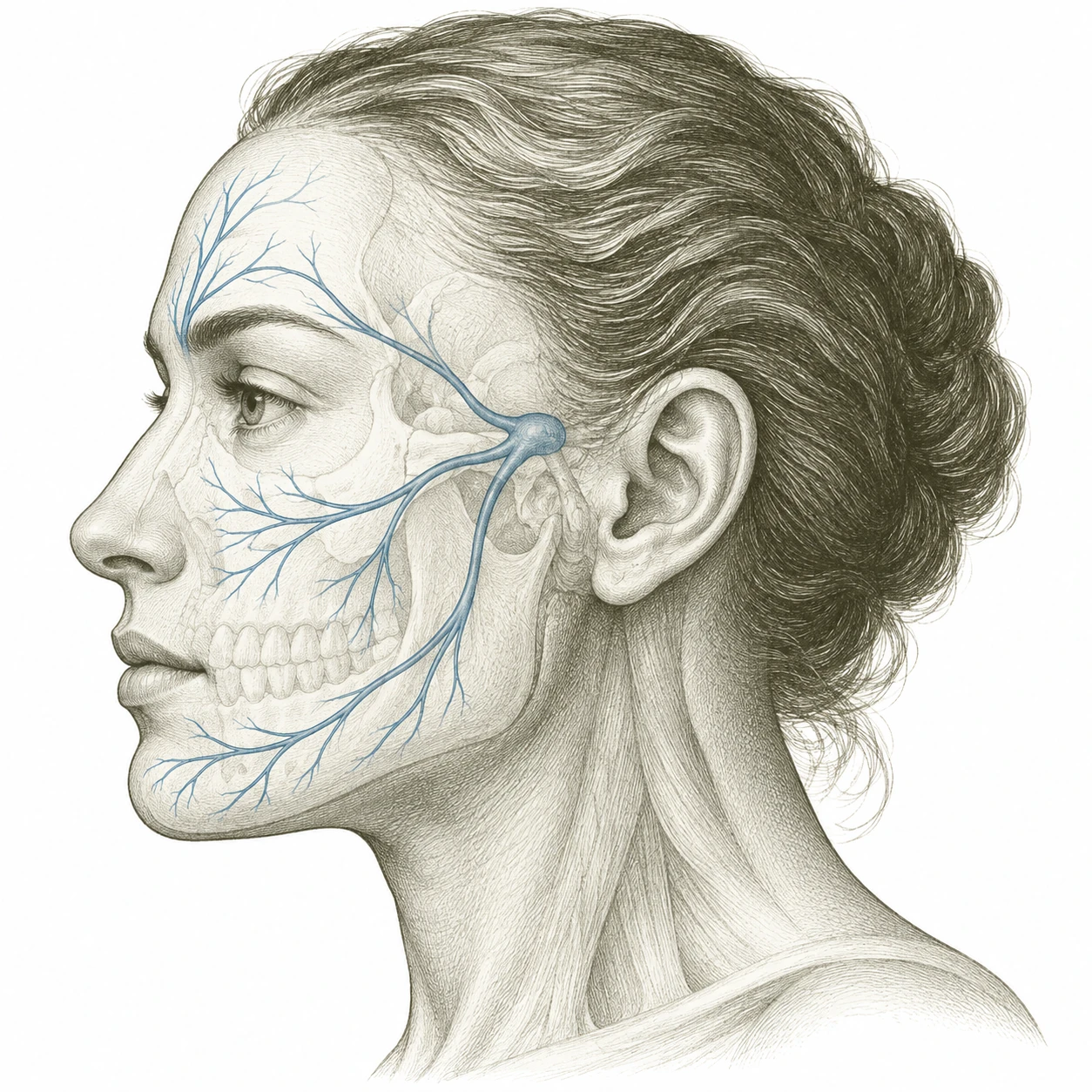
The trigeminal nerve carries sensation from much of the face, including the forehead. Its pain pathways meet those from the upper neck. This connection helps explain why neck and head pain can occur together; it does not prove that a nerve is trapped.
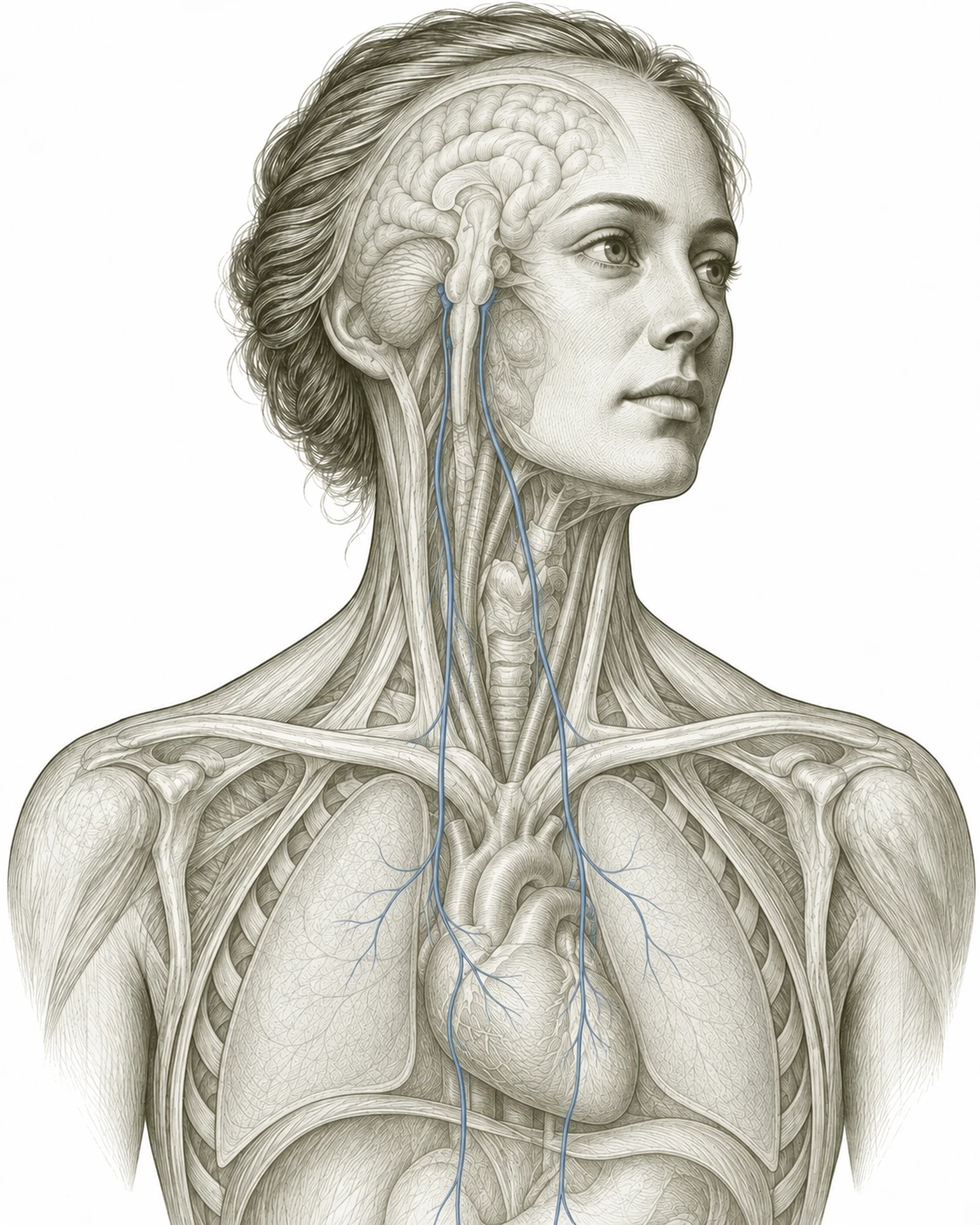
The vagus nerve travels through the neck and helps control functions such as heart rate and digestion. Some migraine treatments use a device to stimulate it electrically. That research does not show that massage or stretching removes pressure from the nerve.
Simplified illustrations show general pathways. They do not identify the cause of an individual headache.
Pressure around the temples, forehead, or base of the skull is a real sensation. It can occur with muscle tenderness or a sensitive pain system. The feeling itself does not establish pressure on the vagus or trigeminal nerve.
Read more: International Headache Society: headache from the neck · NINDS: migraine · PRESTO: electrical vagus nerve stimulation
Reviewed by Chris Corona · Review confirmed